

A regional plumbing operator signed a twelve-month agreement with a marketing firm promising three hundred leads a month. The leads arrived. Call volume tripled inside six weeks.
Dispatch could not absorb it: technicians were double-booked, response times slipped past the four-hour window the company had built its reputation on, and roughly a third of the calls turned out to be outside the service radius or looking for work the company did not perform.
The contract measured success in lead count. Nobody had defined what a usable lead looked like before the campaign launched.
That gap between volume and fit is common because lead count is easy to sell and easy to report, while serviceable, profitable demand takes work to define before a dollar is spent.
Most agencies will hit a volume target. Almost none will ask, unprompted, whether the operator’s trucks, technicians, and dispatch board can absorb what that volume produces.
The fix starts before any vendor conversation, with a written definition of what growth is supposed to look like inside the company’s own operating limits.
What Must A Plumbing Growth Partner Be Able To Deliver?
A plumbing company does not need more leads. It needs more booked, profitable jobs that its existing or planned crew capacity can actually complete without degrading response time or workmanship.
That distinction changes how a partner should be evaluated from the first conversation, because a vendor optimizing for lead count and a vendor optimizing for booked, margin-positive work will build entirely different campaigns, even using identical channels.
Before any partner is contacted, the internal team responsible for hiring one should write down its own numbers. This becomes the selection brief every proposal gets measured against, not a general sense of “more work coming in.”
- Service mix the partner should generate demand for (drain, water heater, repipe, emergency, maintenance) and which lines are excluded.
- Service radius in miles or drive time, including any zones the company will not dispatch to regardless of demand.
- Calls answered versus calls received, since a lead that never gets answered is a lost acquisition cost, not a missed opportunity created by marketing.
- Booked estimates as a share of qualified calls, the number that actually reflects sales performance rather than lead flow.
- Response-time standard the company commits to publicly and cannot exceed without reputational cost.
- Technician and dispatch capacity, stated as a ceiling, not an aspiration.
- Close rate on booked estimates, tracked by job type.
- Average ticket by service line, since a partner chasing volume in low-ticket categories can look successful while eroding margin.
- Maintenance-plan attachment rate as a measure of recurring revenue built alongside one-off jobs.
- Repeat work generated from the existing customer base, not new acquisition alone.
- Margin protected after acquisition cost, labor, and materials.
- Acceptable acquisition economics, meaning the maximum the company will pay per booked job relative to average ticket and margin.
What Demand Fit Actually Means
Demand fit means the campaign targets the service lines, price points, and geography the company can profitably serve, not the broadest audience a channel can reach.
A partner unwilling to narrow targeting to match this is optimizing for their own reporting, not the client’s crew.
Where Operational Capacity Sets The Ceiling
Capacity is the hard limit on any growth plan.
A company with four technicians and a same-day response promise cannot absorb the same lead volume as one with fourteen trucks and a next-day standard, regardless of what either marketing budget can technically buy.
Which Growth Partner Model Fits The Company’s Needs?
Channel labels like “SEO agency” or “lead gen platform” describe a tactic, not who owns execution, who carries risk when performance dips, or who keeps the institutional knowledge when the contract ends.
Those three questions matter more than the channel mix a proposal leads with.
- A full-service marketing partner manages strategy, execution, and reporting directly, while the company sets qualification rules and the partner tunes targeting against them; the operational burden on the company stays low because it reviews and approves rather than builds.
- A specialist channel provider, paid search only, for instance, owns one channel well but leaves the rest of the funnel to the company, so account ownership is shared and demand control is only partial.
- A lead marketplace owns generation but not qualification, often selling the same leads to multiple buyers, which pushes a high operational burden back onto the company’s own phones.
- An in-house-led hybrid puts the company in full control of strategy and data, with contractors executing against its rules, but that only works where the company already has real internal marketing competence.
No structure is universally correct.
A company with an internal marketing hire and a preference for control fits the hybrid model. A company that wants one accountable point of contact and no internal marketing headcount fits a full-service partner.
A specialist provider works only if the company already has the rest of the funnel covered elsewhere. A lead marketplace shifts qualification cost onto the company’s own phones, which is rarely worth the lower sticker price once dispatch time is counted.
What Services Should A Plumbing Digital Marketing Strategy Include?
A booked job traces back through several connected touchpoints:
- someone finds the company through local search or a Google Business Profile,
- lands on a website built to convert rather than just inform,
- arrives through paid demand capture if the company runs ads,
- gets influenced by content and creative that built trust beforehand,
- has their call handled well enough to book,
- and checks reviews before or after.
Each piece feeds the next; treating any one in isolation misses where a job actually gets lost.
That connective work is what a genuine digital marketing strategy does that a bundle of disconnected tactics does not.
A capable digital marketing agency for plumbers should be able to state, in writing, which of these pieces it owns, which it advises on, and which stays with the company, rather than claiming vague full-funnel coverage that nobody can be held to.
What Local-Demand Foundations Require
Local-demand work covers Google Business Profile accuracy, service-area pages, review generation, and citation consistency.
This is the foundation because most plumbing searches carry local intent, and a weak local presence undercuts every paid dollar spent pointing traffic at it.
What Paid-Demand Controls Should Look Like
Paid demand capture needs geographic and service-line targeting tied directly to the capacity numbers set earlier, with negative keywords and dayparting controls that prevent spend on calls the company cannot service, not just controls that maximize click volume.
How Should Marketing Partner Performance Be Measured?
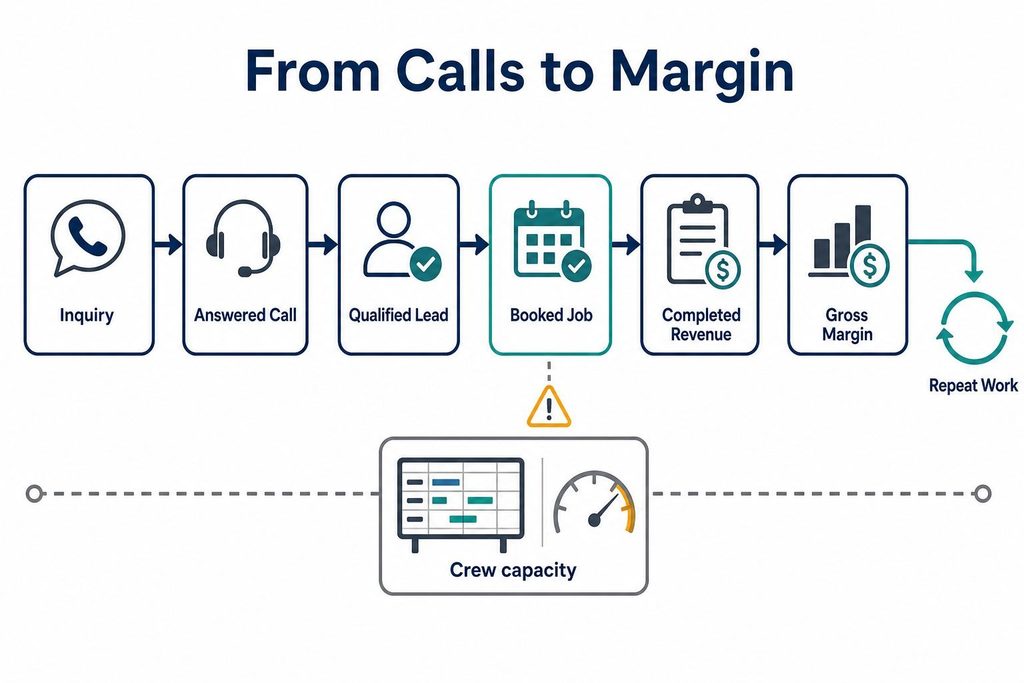
Every reporting conversation should follow the same chain:
- an inquiry becomes an answered call,
- an answered call becomes a qualified lead,
- a qualified lead becomes a booked job,
- a booked job becomes completed revenue,
- revenue produces a gross-margin contribution,
- and some share of that customer returns for repeat work.
A report that stops at inquiry or at cost per lead has described the first link in a six-link chain and called it the whole thing.
A monthly scorecard should carry the same measures every month, from every partner, so performance can be compared over time and across vendors rather than reinterpreted each cycle.
- Cost per lead, tracked by source, not blended across channels.
- Lead quality, defined against the service-mix and radius criteria set in the selection brief.
- Conversion rate from qualified lead to booked estimate.
- Booking rate from estimate to signed job.
- No-show rate for both estimates and scheduled jobs.
- Acquisition cost per booked job, not per raw lead.
- Customer lifetime value, including maintenance-plan and repeat-work revenue.
- ROI, calculated against margin, not revenue alone.
- Capacity variance, meaning how far actual booked volume ran above or below what dispatch could absorb.
What makes this scorecard trustworthy rather than decorative is the infrastructure behind it.
Call tracking has to be in place before the first campaign launches, not added once volume becomes a problem. Reporting needs a fixed cadence rather than an ad hoc call whenever a number looks off.
Source-level definitions have to be agreed in writing so “qualified lead” means the same thing in month one and month nine. And a routine lead-quality review, not just a cost review, is what catches drift before it shows up in revenue.
Financial and buyer-facing measures such as earnings quality, EBITDA, or valuation multiples belong in a different conversation.
A 2025 plumbing valuation benchmark shows businesses in the $500,000 to $1.5 million revenue range typically selling at 2.5x to 3.5x SDE, with larger, platform-ready operations reaching 4.0x to 5.5x SDE or higher in private-equity-style deals.
That context matters for long-term planning. It says nothing about whether last month’s leads produced profitable jobs.
How Can A Growth Plan Avoid Overloading The Field Fleet?
The first thirty days should not include a launch.
They should establish baseline answer rates, current close rates by job type, actual technician availability by day and shift, and a written routing rule for what happens when call volume exceeds dispatch capacity on a given day.
Skipping this step is how a company ends up with the double-booked technicians and slipped response times described at the start.
The next thirty days test serviceable demand at a deliberately modest spend level, watching call disposition closely:
- how many calls fall inside the service radius,
- how many match the intended service mix,
- how many convert to booked estimates.
Only after that window should the partner scale spend, and only on the channels that produced calls the crew could actually absorb at the promised response time.
What Capacity Signals To Watch
Rising no-show rates, slipping response times, and technicians working past scheduled hours are all signs that demand has outrun capacity before revenue numbers show it.
When To Escalate On Lead Quality
A sustained rise in out-of-radius or mismatched calls should trigger an immediate review call with the partner, not a wait-and-see approach.
If the partner cannot explain the shift or correct targeting within one billing cycle, spend on that channel should be paused, not merely questioned, until qualification rules are rebuilt.
What Must The Partnership Agreement Say Before Work Begins?
A proposal is a set of promises. An agreement is what makes those promises enforceable, and it is the document that determines whether a company can actually act on everything defined above once work starts.
Who Owns What
The agreement needs to state, by name, who administers the ad accounts, analytics, call-tracking platform, creative assets, and business listing profiles.
It needs to confirm the company retains administrator-level access to each one regardless of who manages day-to-day work.
It should also disclose whether leads are exclusive to the company or shared with competitors through the same channel.
What Governs Money And Exit
Budget allocation across channels, the creative approval process, reporting cadence, and the change-control process for adjusting targeting mid-contract all belong in writing.
So do contract length, cancellation terms, and what happens to data and account access on termination. Every escalation route should name a specific role, not a general support inbox.
How Can A Plumbing Company Verify A Partner Before Signing?
Does the partner have a track record in plumbing specifically, not home services broadly? Ask for:
- references
- at least two case studies that define, in writing, what counted as:
- a lead
- a booked job
- a conversion, since those definitions vary widely between agencies.
What happens to leads that don’t convert, and does the partner share leads across multiple clients in the same market? A vendor unwilling to answer plainly is disclosing something by omission.
Can the partner describe a time performance dropped and how they corrected it? An agency with no example of failure is either new or not being candid.
Who is accountable when calls stop converting, and what local-service expertise do they bring to plumbing specifically versus general contracting?
Certain answers should end the conversation regardless of price:
- guaranteed volume with no qualification criteria,
- accounts or data the company cannot access directly,
- dashboards that report clicks and impressions with no line back to booked jobs,
- unexplained shifts in budget allocation between channels,
- and a sales process that never asks about technician or dispatch capacity at all.
What Is The First Request To Send A Shortlisted Growth Partner?
Every finalist should receive the same written request before a sales call happens, worded identically so the responses can sit next to each other.
A phone conversation lets a skilled salesperson reshape the pitch to whatever the company seems to want to hear. A written request, sent to multiple vendors at once, does not allow that.
Gaps in scope, ownership, measurement, or contract terms show up as gaps in the response itself, not as something a specifier has to infer from tone.
The request does not need to be long. It needs to force specificity on the five things that determine whether a partner can be trusted with the company’s dispatch board and margin, not just its marketing budget:
- what they will actually do,
- who controls the accounts and data,
- how success gets measured monthly,
- what happens when lead quality slips,
- and what it costs to leave if the fit is wrong.
Send this, unchanged, to every shortlisted partner before any call is scheduled:
Please respond in writing before we schedule a call:
- The specific service mix and service radius your proposed campaign will target.
- Who retains administrator access to ad accounts, analytics, call tracking, and our business listings.
- The exact monthly scorecard measures you report, with your definitions of a qualified lead and a booked job.
- Your process for escalating and correcting when lead quality drops.
- Contract length, cancellation notice, and what happens to our data and accounts if we leave.