

A polished monthly report is the weakest piece of evidence in a plumbing SEO proposal, not the strongest. Ranking screenshots, keyword counts and a green traffic graph are trivially easy to produce and almost impossible to tie to a single booked job. The agencies that resist an audit hardest are usually the ones whose reporting looks best on the surface.
That gap between presentation and proof is exactly what an evaluator has to close before signing anything. The rest of this comparison treats an audit as a set of separate, checkable claims rather than a narrative. Each one either has evidence attached or it does not.
Define the Seo Audit Before Reviewing an Agency
A plumbing SEO audit is an evidence-led inspection of four things:
- whether the site can be found and crawled
- whether it appears correctly in local search
- whether visits convert into trackable calls
- and which fixes are prioritized and why
It is not a rankings screenshot, and it is not a narrative summary written after the fact. Every deliverable an agency claims to have produced should be confirmable as either present in the file or absent from it. There is no third category.
That distinction matters because the four dimensions do not substitute for one another. A site can crawl cleanly and still lose calls because the phone number on the page does not match the one in the call-tracking system. A business can rank for “emergency plumber” and still fail to convert because the page routes visitors to a contact form instead of a click-to-call button. Each dimension has to be checked on its own terms.
Consider a routine scenario: a search for “water heater repair near me” returns the contractor’s site in the map results, and traffic to that page rises for the month. On its own, that traffic tells an evaluator nothing about whether a single water heater job got booked. The visit could have bounced, the call could have gone unanswered, or the caller could have been quoted and never followed up.
Traffic is a precondition for revenue, not evidence of it.
The sections that follow treat crawl and indexing, local signals, competitive gaps, reporting quality, tooling and agency conduct as separate lines of inquiry. An agency can pass one and fail another. An audit that only reports on the dimension it is strongest in is not incomplete by accident.
Inspect the Crawl, Indexing, and Page Foundations
Nothing downstream matters if the pages in question are not reliably crawlable and indexed. A ranking claim built on a page that Google cannot consistently access is not a finding, it is a coincidence waiting to reverse itself. This is the layer an audit has to clear first, because every later claim about visibility inherits its accuracy.
A credible technical and onsite review, following the structure laid out in a 2026 technical SEO guide, produces a checkable list rather than a paragraph of adjectives:
- Crawl and indexation status for each priority URL, with the crawler used and the date checked
- Core Web Vitals scores per template (homepage, service page, emergency page)
- Canonical and duplicate-content configuration, including any conflicting tags found
- Redirect chains and server errors (4xx/5xx) logged by URL
- Service-page targeting, confirming distinct pages exist for core services rather than one blended page
- Title tag and heading coverage across the indexed template set
- Internal navigation from homepage to service pages to conversion points
- Conversion paths for emergency calls versus scheduled/routine bookings, checked separately
Verify Access and Index Coverage
For every item above, the agency should be able to show the affected URLs, the diagnostic method used to find the issue, a priority ranking, and a proposed fix. A finding with no URL attached cannot be verified and should not be accepted as complete.
One check deserves specific attention because it is genuinely measurable rather than descriptive. A site search using site:yourdomain.com should return a count of pages roughly in line with the indexed count shown in Search Console. A 2026 playbook on technical audits treats a discrepancy beyond roughly 20% as a signal worth investigating, not a guarantee of a problem, but a legitimate flag that the agency should explain rather than ignore.
Verify Service-Page Relevance and Conversion Paths
Separately, each core service (drain cleaning, water heater repair, leak detection, emergency plumbing) needs its own page with a clear path to a call or booking action, and the audit should confirm which services currently lack one.
Benchmark the Search Gap Against Local Competitors
A competitor comparison is only evidence if it names names. The agency should document which competitors were reviewed, which service queries and location modifiers were tested (drain cleaning plus city name, emergency plumber plus city name, and equivalents), and whether the observation was a standard search result, a map pack listing, or both.
The distinction that matters here is between a documented gap and an assertion. “Competitors are outranking you” is a claim. A screenshot of the map pack for a named query, on a stated date, showing three competitor listings above the contractor’s own, is a gap.
Only the second is auditable.
Where a contractor operates in more than one state, the same location-specific documentation should exist for each market, including California and Texas gap queries where those apply. The evidence available does not establish that competitors behave differently by state, and an agency that presents state-specific competitor patterns as a finding is asserting something the underlying search data does not support.
Compare the Reports That Prove Search Performance
Report quality should be judged by whether each line traces back to a source, not by whether the agency labels its leads “qualified” or “unqualified.” No standard exists across this evidence for what qualification means, so a report that leans on that language without defining it is adding a term rather than adding proof.
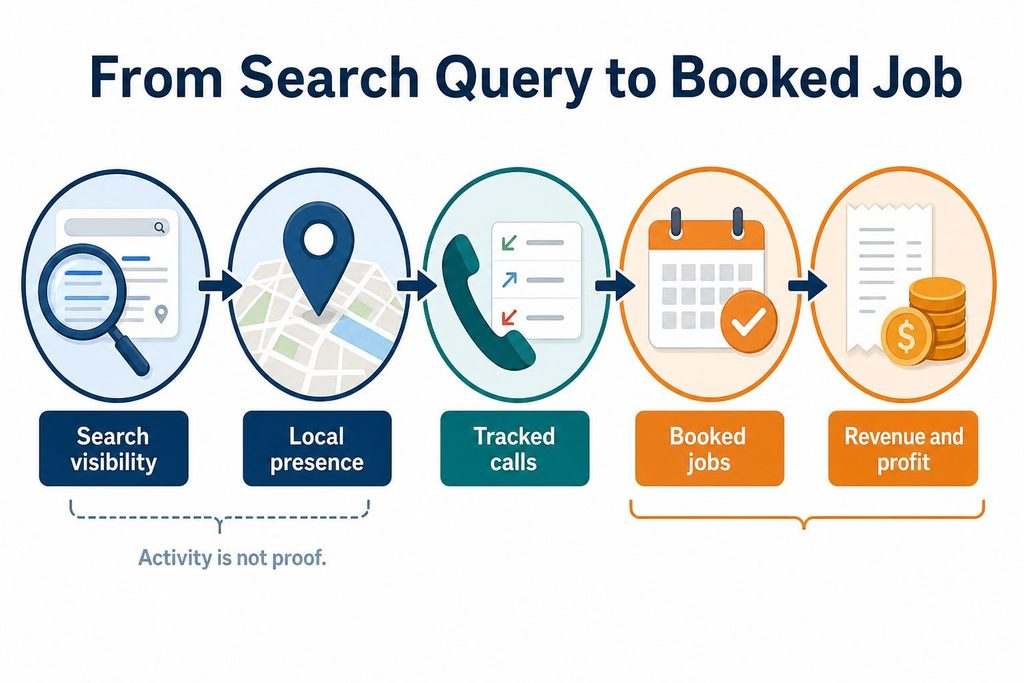
Four categories of reporting cover the ground that matters, and each should be checkable against a different piece of underlying data.
| Report Component | Evidence to Request | Red Flag When Absent |
|---|---|---|
| Search visibility and index coverage | Search Console export showing indexed pages and query performance | Rankings claimed with no Search Console data behind them |
| Local and map presence | Dated map-pack screenshots for named queries and locations | Local visibility described in general terms with no query shown |
| Call tracking and lead quality | Call log with source, answer status, and duration per call | Lead count reported with no answer rate or call source |
| Booking and job economics | Booked-job count, cost per booked job, booked revenue, gross profit | Lead volume presented as the final outcome measure |
A 2026 plumbing marketing ROI guide points to answer rate, booking rate, cost per booked job, booked revenue and gross profit as stronger measures than raw lead count wherever the contractor’s own operations data can supply them. An agency that cannot connect its reporting to any of those figures is reporting on activity, not results.
Verify the Local Signals That Route Plumbing Calls
Local visibility is a consistency and measurement problem before it is a ranking problem. A listing that shows the wrong phone number routes calls nowhere useful regardless of where it ranks.
Google Business Profile Evidence
The agency should show:
- which Google Business Profile standards it reviewed
- the current profile status
- categories
- service-area settings
- and confirm that name, address, and phone details match across:
- the website
- the profile
- and any directory listings checked
Google Webmaster Guidelines and Google Business Profile standards should appear here only as the standards the agency says it checked against, not as a list of extra requirements invented for the review.
Phone and Service-Area Evidence
Separately, service-area treatment (which cities or zip codes are claimed) needs documentation, along with map-query observations for the core service terms. A call-tracking method that preserves the source of each call, whether it originated from organic search, the map listing, or paid activity, is what turns a call log into evidence rather than a raw number.
Test the Tools and Monitoring Loop
A finding that cannot be reproduced next month is not a monitoring system, it is a one-time snapshot. Repeatability depends on the agency naming its sources plainly rather than describing outputs in general terms. The following should each be a specific access, export, screenshot, or written process, not a description:
- Crawl source used for technical findings, named and version-dated
- Search Console access or export the evaluator can review directly
- Analytics source feeding traffic and conversion figures
- Rank or map observation method, including query list and location
- Call-tracking source and how call sources are preserved
- Reporting cadence, stated as a fixed schedule
- KPI owner, a named role responsible for each metric
- Remediation log tracking fixes proposed against fixes completed
Tools do not substitute for judgment. A dashboard full of exports with no written interpretation of what changed and what gets fixed first is not an audit, it is a data dump with a login attached.
Reject the Agency Red Flags Before Signing
Certain patterns in a proposal are disqualifying on their own, regardless of how the rest of the package looks. Rankings-only reporting, with no crawl data, no call log and no booking figures, answers a question nobody asked. Lead totals presented without answer rate or booking context hide the difference between a call center and a scheduling system.
The failures worth walking away from tend to repeat across proposals in the same few forms:
- An audit score with no methodology behind it
- A report with no URL-level findings
- A competitor comparison with no named competitors and no dated screenshot
- Inaccessible data accounts, where the agency cannot produce Search Console or call-tracking logins for the evaluator’s own business
- Fixes listed with no owner and no priority order
- Guarantees offered with no baseline to measure them against
These are the same failure wearing different labels: a conclusion with no visible working.
Reviewing how an established provider frames these deliverables, such as the comparison notes in plumbing seo services, can help calibrate what a documented proposal looks like before any single vendor’s pitch is taken at face value.
Request the Audit Evidence in Writing
None of the preceding checks can be compared across agencies until each one is answered in writing, in the same format, for the same set of pages and the same time window. An agency that supplies technical findings, onsite conversion checks, local-signal evidence, a competitor comparison with named queries, a KPI report tied to bookings, and a remediation log with owners attached has cleared the bar. One that supplies a narrative summary and a rankings chart has not, no matter how confident the narrative sounds.
The next step is small enough to send today: a short written request, sent to every agency still under consideration, asking for the same five things before any proposal gets ranked against another.
Send this to each agency under review, unedited:
Please provide, for the current site: (1) the audit scope and pages reviewed, (2) URL-level findings with priority order, (3) documented competitor and local-search evidence with dated screenshots, (4) a sample KPI report showing call-to-booking data, and (5) who owns data access and remediation going forward.
What comes back, or does not, is the comparison.