

An HVAC operator increases monthly lead spend by forty percent after a slow shoulder season, expecting the schedule to fill in proportion. Call volume rises. Booked jobs do not, not by much. Technicians still finish Tuesday afternoon with nothing queued for Wednesday morning, and the invoice from the lead vendor arrives on schedule regardless.
This happens often enough to be the default outcome rather than the exception, because lead volume and booked capacity are treated as the same problem when they are not. One is a marketing metric. The other is a dispatch outcome, and it depends on how fast someone answers the phone, what the caller actually needs, and whether the appointment matches a service the crew can deliver that week.
What Does It Take To Book Technicians Year-Round?
A steadier schedule is not the same target as:
- more traffic
- more form submissions
The result worth managing toward is a predictable flow of qualified calls that:
- convert into booked appointments
- produce estimate opportunities that get followed up
- generate service agreements where appropriate
- keep technicians working at a level the business can actually staff for
- Everything else, including impressions and keyword rank, is a proxy that may or may not connect to that outcome.
The pipeline that produces this result runs in a specific order. Someone searches locally for a repair, a maintenance visit, or an installation quote. They find a business, or several, with visibility in that moment. They contact one, by call or by form. Someone on the receiving end responds, quickly or not, and either books the job or loses it.
That chain has four links:
- Search visibility, whether the business shows up when someone nearby is looking for the exact service they need
- Response handling, how fast and how well a call or form submission gets answered
- Booking conversion, whether that response actually turns into an appointment on the schedule
- Technician utilization, whether the appointments booked match what the crew can staff that week
A weakness anywhere in that chain shows up as wasted spend somewhere upstream of it, even when the upstream part looks like it is working. Because of that dependency, the sequence that follows here is intentional.
- Local visibility and the site’s ability to convert a visit into contact come first, since paid demand poured into a broken funnel just raises the cost of the same leak.
- Controlled, capacity-matched paid campaigns come second, tested at a scale the business can staff before it is expanded.
- Follow-up discipline and source tracking come last in the build order but they are what makes the first two measurable at all.
- Skipping ahead to more spend before the earlier stages are sound is the single most common way a marketing budget gets spent without moving the schedule.
Why Does More Lead Volume Fail To Fill The Schedule?
Lead price by itself answers nothing. A dollar figure per lead says nothing about how many of those contacts were actually looking for the advertiser’s service area, how fast they were reached, or what happened after the call ended. Market conditions vary by category and by demand source, and how saturated a given channel is for a given business cannot be assumed from the outside; it has to be checked against that business’s own conversion data.
| Demand Source | Targeting Control | Qualification Checks | Budget Risk |
|---|---|---|---|
| Owned local visibility (search, maps, reviews) | High, tied to actual service area | Moderate, self-selected by search intent | Low marginal cost per additional call |
| Paid search or Local Services Ads | High, by geography and service category | Platform-dependent, varies by setup | Controlled by budget and bid settings |
| Pay-per-call or flat-rate lead offers | Limited, set by the seller’s criteria | Often unverified before purchase | Fixed regardless of booking outcome |
| Exclusive-lead claims | Limited, exclusivity not independently confirmable | Unverified without direct testing | Premium paid without proof of yield |
The comparison is not an argument for one source over another. It is an argument for measuring each one against the same downstream number: how many of these contacts became booked, revenue-producing appointments.
How Can Google Visibility Produce Local HVAC Service Calls?
Local search intent is the first source of demand a business can influence directly without paying per contact, which is why it comes before any paid channel in the build order. Someone searching “AC repair near me” or “furnace installation [city]” is already close to a decision. Whether that search turns into a call depends on whether the business shows up accurately, looks credible, and gives the searcher an obvious next step.
Three workstreams govern that outcome, and each has its own maintenance requirements.
Google Business Profile Accuracy and Review Credibility
The listing has to reflect the current service categories, hours, and coverage area, because a mismatch here silently redirects calls to a competitor whose listing is simply more current. Review volume and recency matter less as a vanity number and more as a trust signal a searcher checks before dialing.
Service Pages Matched To Real Coverage
A page claiming coverage in a city the business does not actually dispatch to produces calls that get declined, which wastes both the searcher’s time and the business’s response capacity. Pages should exist only where trucks genuinely run, and content aimed at urgent repair searches needs a different contact path than a maintenance-plan page; one calls for click-to-call prominence, the other can route through a scheduling form.
The following sequence makes each workstream operational rather than aspirational:
- Audit the Business Profile against current service categories, hours, and coverage, correcting any mismatch found.
- Request reviews systematically after completed jobs rather than sporadically, since consistency affects both volume and recency.
- List only cities and zip codes actually served, removing or consolidating pages for areas outside real dispatch range.
- Place a phone number and appointment request above the fold on every service and location page, not buried after the copy.
- Track calls and direction requests from the Business Profile separately from website contact, since they represent different points in the funnel.
Rankings are a byproduct of this work, not its purpose. The purpose is calls, direction requests, and appointment requests that a dispatcher can act on the same day.
What Must An HVAC Website Do Before It Can Convert A Lead?
A generic homepage sent traffic meant for a specific search or ad rarely converts well, because the visitor arrived expecting confirmation of what they searched for and instead found a broad overview of every service the company offers. That mismatch is the most common and most fixable failure point in the funnel, and it sits between visibility and booking, where a lot of paid spend quietly evaporates.
The landing page a visitor reaches has to mirror the search or ad that brought them there: same service named, same location referenced, no generic redirect to a homepage that makes the visitor re-orient. The offer stated on that page should describe what is included without unsupported savings figures.
A few elements have to be in place near the point of decision, not lower on the page:
- Phone number and appointment request, visible without scrolling
- Service-area confirmation, so the visitor knows the business actually covers their location
- Review signals, positioned where the decision gets made, not buried in a separate page
- Automatic source logging, so every call or form submission records where it came from without depending on someone remembering to note it
Two numbers reveal whether this stage is working: booked appointment rate among people who reach the page, and missed-contact rate among people who call or submit a form and never get a response logged. A landing page that gets clicks but shows a low booked rate against a normal missed-contact rate is not a visibility problem. It is a page problem, and no amount of additional traffic fixes it.
How Should Google Ads And Local Services Ads Be Limited To Available Capacity?
Paid demand should be tested at a scale that matches what the crew can actually handle that week, not scaled to whatever the budget allows. The sequence starts by choosing one service, such as AC repair or furnace replacement, and one constrained geography rather than the entire service area at once. That campaign connects to a landing page or a direct call path built for that exact service and location, following the same matching principle covered above.
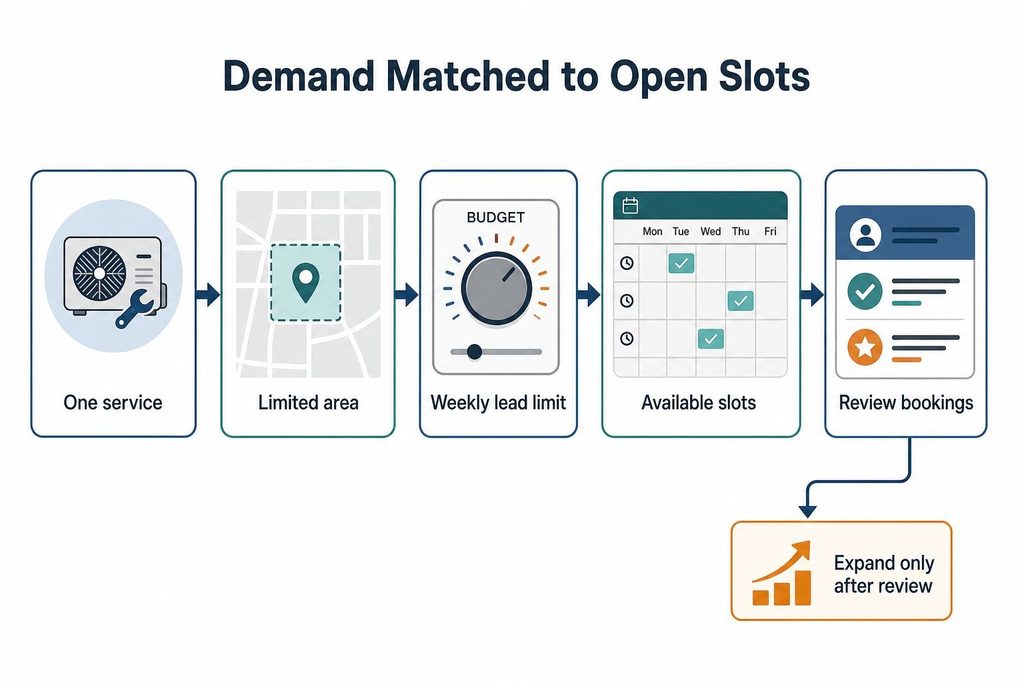
A test budget gets set against real dispatch capacity, not against an aspirational lead count. Google Local Services Ads specifically allow targeting by zip code or city, and the advertiser can set a weekly budget based on the number of leads it can actually handle, which makes this the more direct capacity control between the two ad types.
Every lead from either platform gets recorded by source through to booking outcome, and the campaign only gets adjusted, expanded, or reallocated after that lead-quality data has been reviewed, not before.
None of this implies a particular cost, a particular volume, or that a lead from either platform is exclusive to the business receiving it. It is a mechanism for keeping the demand generated in proportion to the crew available to answer it.
How Can Follow-Up Recover Unbooked HVAC Estimates And Inquiries?
Every inquiry needs a source and a service need logged in the CRM at intake, along with response time and booking disposition, so that a follow-up gap is visible rather than assumed. One person should own estimate follow-up specifically, since unassigned follow-up tends to default to nobody.
Texts and automated reminders help move a stalled estimate forward but do not replace a documented process. Any email sequence used for follow-up should be run with CAN-SPAM Act and GDPR in mind as the applicable regulations. Lost-reason review, done regularly, tends to surface either a qualification problem upstream or a staffing gap downstream, and the two require different fixes.
What Should Be Checked Before Approving More HVAC Marketing Spend?
Proof that a channel works is a traceable chain, not a dashboard. It runs from source through response time, through qualified inquiry, through booked job, through completed revenue, to technician capacity used. A vendor’s own reporting on clicks or calls generated stops well short of that chain and should never be treated as the end of it.
Before approving additional spend, three checks belong in this order, and the order matters because each one depends on the last:
- Audit Google visibility, service-area accuracy, reviews, conversion routes, and CRM source capture first, since a broken step here invalidates any conclusion drawn from spend data.
- Reconcile a sample of recent inquiries against actual booking outcomes, once the audit confirms the tracking behind those inquiries is trustworthy.
- Fix one identified broken link before expanding spend, because adding budget to an unrepaired funnel compounds the existing waste rather than solving it.
The audit has to come first because reconciling numbers pulled from a broken tracking setup produces a false picture either way. Reconciliation has to come before any budget decision because a spend increase approved on unverified numbers is a guess wearing the appearance of analysis.
The next forty-eight hours matter more than the next campaign change.
- First, pick a single recent inquiry and trace it by hand from its source through to whatever happened to it, booked, lost, or still open, because that trail is the only evidence a spend decision can stand on, and it has to be checked before anything else moves.
- Second, once that trail is documented, write down exactly where it breaks, whether at response time, at qualification, or at booking, since the fix depends on which link failed.
- Third, only after that break is identified, decide whether the next dollar goes toward repairing that link or toward the audit steps above, because spending before the break is found repeats the same waste this piece opened with.