

A homeowner found a burst pipe at eleven at night, searched for help, and called the third listing down because the top two results led nowhere useful: one had a disconnected number still showing in the map pack, the other listed a service area forty miles from the actual leak. The plumbing company that ranked first lost a same-night job worth several hundred dollars to a competitor who simply answered the phone.
That scenario repeats constantly, and it gets treated as a fluke rather than a system failure. Most plumbing businesses assume that ranking is the finish line.
It is not. Ranking gets a business seen. Whether that visibility turns into a call depends on details that have nothing to do with keyword density and everything to do with whether the listing can be trusted in under ten seconds.
Why Do Urgent Water Damage Searches Miss a Plumbing Business?
Local visibility for an emergency plumber rests on a small number of interlocking pieces: presence in Google Maps results, position within the local map pack, the accuracy of the business listing behind that position, and what happens once a searcher clicks. Each piece feeds the next. A business absent from the map pack never gets evaluated at all. A business present but inaccurate gets evaluated and rejected in the same glance.
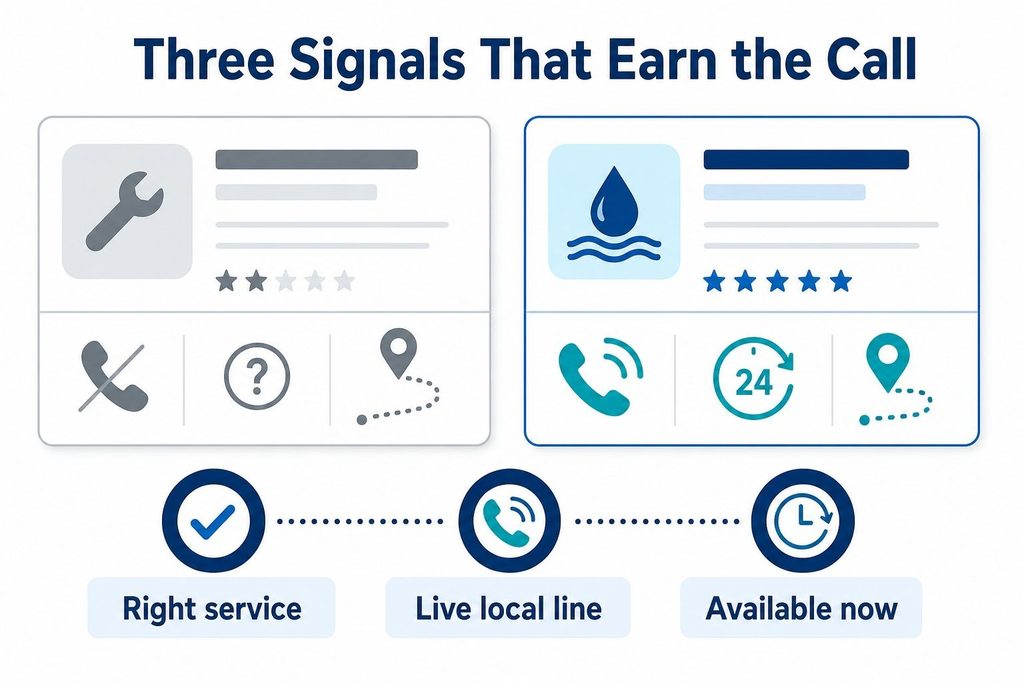
The gap that costs jobs is not usually invisibility. It is a listing that shows up but fails the trust test an urgent caller runs instinctively: is this the right service, is this number live, is this business actually near me right now. A pipe bursting at midnight does not generate a patient searcher. It generates someone scanning three or four map pack results in under a minute and calling the first one that removes doubt.
That distinction, between appearing and qualifying, is where most plumbing marketing conversations go wrong. Search visibility gets treated as a traffic problem when it is really a conversion problem wearing a traffic costume. A business can hold a strong map pack position and still lose the call to a lower-ranked competitor whose listing answers the searcher’s real questions faster.
Getting this foundation right is the difference between local seo for plumbing that produces phone calls and local seo for plumbing that produces impressions nobody acts on. The mechanics matter less than the discipline of checking, constantly, whether the public-facing listing gives an urgent caller a reason to dial rather than scroll.
Three questions decide that outcome for every emergency search:
- Does the listing name the right service? A generic “plumber” category without an emergency or water damage mention loses the searcher who typed exactly that phrase.
- Does it show a live and local contact path? A number that rings through to voicemail or a service area that reads as too far away ends the call before it starts.
- Does it prove someone will actually pick up? Hours, photos, and recent reviews all signal an operating business rather than an abandoned profile.
Get any of those wrong and no amount of ranking work recovers the lost call.
What Makes a Map Pack Listing Trustworthy Enough to Call?
Two plumbing businesses can occupy adjacent map pack positions and produce entirely different call volumes because the underlying listing accuracy diverges in ways a searcher notices immediately, even if they never articulate why one number gets dialed and the other does not.
| Signal | Incomplete Listing | Accurate Listing |
|---|---|---|
| Primary service relevance | Generic “plumber” category, no emergency mention | Emergency and water damage service named directly |
| Phone/contact path | Tracking number that bounces or rings unanswered | Direct line staffed for after-hours calls |
| Operating information | Hours marked closed or unclear at night | Hours or note showing 24-hour emergency availability |
| Photos or proof cues | Stock imagery or none | Job photos, marked vehicles, visible crew |
What Accuracy Actually Fixes
Each row above is not a cosmetic detail. It answers a specific doubt an urgent searcher is running through in real time, and an unanswered doubt ends the interaction before the phone rings.
What Conversion Consequences Follow
A weak signal in any single row depresses click-through rate even at a strong map position, and a weak signal at the contact-path row depresses calls even after the click happens. The two failures compound rather than cancel out.
Which Local Visibility Fix Should Come First?
The instinct is to spread effort evenly across citations, on-page content, and review requests. That instinct is backwards for a business currently losing calls. Fixing anything before correcting the core listing wastes the work, because every downstream signal still points back to whatever facts Google already holds.
The sequence that actually protects revenue looks like this:
- Correct inaccurate business listings first. Any conflicting name, address, phone number, or category across Google Business Profile and major directories gets fixed before anything else, because conflicting data undermines every ranking signal built on top of it.
- Complete the Google Business Profile fully. Service list, hours, service area, and business description all get filled in with emergency-relevant detail once the core facts are confirmed accurate.
- Establish local keyword targeting across the profile description and service pages, aligned to the terms an urgent searcher actually types.
- Measure calls and conversion rate against the corrected baseline to confirm the fix produced contact volume, not just improved appearance.
Citation building, on-page SEO, and review solicitation all assume the underlying business record is correct. They amplify whatever signal already exists. Amplifying a wrong phone number or a mismatched service area just spreads the error further, and it will not be visible in ranking reports because ranking and correctness are measured differently.
How Can a Google Business Profile Win More Emergency Plumbing Calls?
A completed Google Business Profile earns its position in the map pack. Winning the call that follows is a separate task, and it depends on details easy to treat as administrative when they are actually the entire conversion mechanism for urgent search.
What Must Match Everywhere?
Business name, address, and phone number have to read identically across the Google Business Profile, the website, and every directory listing that carries the business. Any variation, a suite number dropped in one place, an old phone number surviving on a legacy directory, creates the exact conflicting-information problem that erodes both ranking confidence and searcher trust.
Service descriptions need the same discipline. If the business handles emergency water damage response, that phrase belongs in the profile’s services section in language that mirrors what someone frantically searching would type, not generic trade terminology.
What Turns an Impression Into a Call?
Verifying the listing shows up is only half the job. The contact path has to survive contact. A phone number that rings through to voicemail during the hours a burst pipe is most likely to happen defeats every ranking effort that got the call that far.
Response time, not just presence, is the metric worth tracking here: how long does it take a call during evening or overnight hours to reach a person. Photos matter for the same reason a live phone matters, they signal that a real, operating business is behind the listing rather than an abandoned or inactive profile.
None of this requires guessing at platform rules. It requires treating the profile as a live operational surface, audited the way a dispatch line would be audited, rather than a one-time setup task filed away after the initial verification postcard arrives.
How Do Citations and Service Pages Reinforce Local Ranking?
A corrected Google Business Profile does the heavy lifting, but the supporting layer, citations and service content, either reinforces that accuracy or contradicts it. The most common failure here is not absence of content, it is content that technically exists but no longer matches the business it describes.
| Asset | Executable Check | Local Signal Reinforced |
|---|---|---|
| Local citations | Confirm name, address, phone match the corrected profile | Listing accuracy across the web |
| On-page SEO | Match service page language to emergency search terms | Local keyword targeting |
| Water-damage service content | Describe the actual response process and coverage | Service area optimization |
| Local partnerships | Confirm the relationship is current and mutually linked | Local citation strength |
Every service-area claim on these pages needs to describe territory the business genuinely covers today, not an aspirational radius drawn to capture more searches. A service page claiming coverage the dispatch team cannot actually fulfill creates the same trust failure as an inaccurate phone number. It is just discovered later, after the call has already been answered and the appointment has already been missed.
How Can Customer Reviews Become a Conversion Signal Rather Than a Vanity Metric?
Review volume alone tells a searcher nothing about whether the business will show up tonight. What moves a decision is recency and relevance, particularly reviews that mention emergency response specifically.
- Request feedback right after the job closes, while the urgency and the resolution are both still fresh in the customer’s memory.
- Route complaints to a response process, not a review page, so operational problems get solved before they become public.
- Track review rating alongside call volume, not in isolation, to see whether reputation signals are actually correlating with contact rates.
Manipulated or batch-solicited reviews read as inauthentic to both searchers and to the platform, and neither promises a ranking benefit worth chasing.
What Should Be Done in the First 48 Hours?
The order matters as much as the actions themselves, because each step depends on the one before it being finished, not just started.
- Start with the highest-risk inaccuracies: any wrong phone number, address, or closed-hours marker on the Google Business Profile gets corrected first, because every other fix depends on that baseline being right. A ranking gain built on top of a wrong phone number is a wasted gain.
- Once that is confirmed, check that emergency-service and service-area pages actually route to working contact paths. This comes second because a corrected profile pointing to a broken page still loses the call, and there is no point auditing traffic sources until the destination itself works.
- After both are stable, record baseline numbers for impressions, click-through rate, calls, jobs, and conversion rate. This step comes last because it needs a stable listing and a working contact path to measure against; recorded too early, the baseline just documents the same problems that are about to be fixed.
Demand for plumbing labor is not the constraint. The Bureau of Labor Statistics projects continued growth in plumbing occupations through the next decade of BLS job openings, and a similar outlook holds in Canada’s labour market projections. The bottleneck sits in whether searchers can find, trust, and reach a specific business fast enough.
Boosting visibility starts with the profile corrections above, not paid promotion. Getting customers from search depends on the contact path working, not on volume of content. The 80/20 rule here means the listing-accuracy and profile-completeness work drives most of the outcome, while broader content efforts fill in the remainder. Demand itself is not the limiting factor: the ability to capture it, cleanly and quickly, is.
The one thing to do today is audit the public phone number, address, and service description exactly as a searcher would see them, across the Google Business Profile and the website, side by side. Tomorrow, follow that with the contact-path check and the baseline numbers, in that order, so the 48 hours end with a listing that is not just accurate but proven to work.