

A plumbing site can double its organic traffic in a year and still lean on rented leads every time a pipe bursts at 11 p.m. That is not a paradox. It is what happens when visibility and buying intent are treated as the same thing.
Most audits stop at the traffic report. Sessions are up, so the story is written as a win, and the marketing spend gets renewed on that basis alone. The number that actually matters, calls from someone standing in water right now, rarely gets checked against it. The gap between those two numbers is where budget gets wasted and where it can be recovered.
Why Does More Organic Traffic Not Always Mean More Plumbing Calls?
Organic traffic is not one audience. It is several audiences with different problems, different timelines, and wildly different value to a plumbing business, all folded into a single line on a dashboard. A homeowner researching “why does my drain gurgle” months before anything fails is not the same lead as one searching “emergency drain cleaning near me” with water already on the floor. Treating them as equivalent traffic is how a growing site keeps depending on rented leads for the jobs that actually pay.
Scope matters here too: organic search builds durable, owned visibility for local emergency plumbing demand. It does not replace paid acquisition outright, and it will not fill a call log on its own in the short term. What it does is compound, in a way rented leads never do.
| Search Intent | Appropriate Page | Business Outcome |
|---|---|---|
| Broad informational (“why is my pipe leaking”) | Educational blog or FAQ content | Builds trust and topical relevance, rarely converts same-day |
| Urgent service (“emergency drain cleaning near me”) | Dedicated emergency service page | Direct call or form, immediate revenue potential |
| Pricing or reassurance (“emergency plumber cost”) | Pricing-context FAQ linked to service page | Qualifies the lead before contact, reduces wasted calls |
A site can rank well for the first row and still starve the business, because that traffic was never going to call today.
Why Should Local Map Visibility Come Before More Plumbing Blog Posts?
The cost of being invisible at the moment someone’s basement is flooding is not a missed pageview, it is a job that goes to whichever plumber shows up first in the map pack. That searcher is not going to scroll to page two, and they are not going to read a blog post about pipe maintenance while their kitchen fills with water. Publishing another article while the Google Business Profile sits half-finished is optimizing for the wrong moment in the customer’s day.
What a Profile Actually Needs to Be Complete
A profile earns trust through specificity, not volume. Primary and secondary categories need to reflect what the business actually does, drain cleaning, pipe repair, emergency response, not a generic “plumber” label that competes against every general contractor in the area. Service areas need to be defined honestly, not padded to cover a radius the crew cannot realistically reach at 2 a.m.
Hours matter more here than almost anywhere else on the profile. If the business genuinely answers calls around the clock, that needs to be reflected accurately, including holiday hours. If it does not, claiming 24-hour availability and then sending an urgent caller to voicemail does more damage than a modest, accurate listing ever would.
What Review and Operational Accuracy Protects
Localized review evidence, meaning reviews that mention the neighborhood, the type of job, or the specific problem solved, carries more weight with both searchers and the algorithm than a generic five-star count. A review that says “fixed our burst pipe on a Saturday night in [neighborhood]” does more work than ten reviews that just say “great service.”
Consistency across every listing:
- the business name
- address
- phone number
matching exactly across:
- the website
- the profile
- any directory the business appears on
removes a quiet source of doubt that neither customers nor search engines forgive easily.
- No claim here guarantees a specific map position.
What can be said plainly is that:
- inconsistency
- inaccuracy
are the more common reasons a qualified, capable plumber stays invisible next to someone doing less work but doing the basics correctly.
What Should an Emergency Plumbing Searcher Find First?
A person with a blocked drain backing up into their bathtub and a person reading about drain maintenance on a Sunday afternoon are both technically “organic traffic,” and treating their needs identically is the fastest way to lose the one who actually matters right now. The first wants a phone number and confirmation that someone can come today. The second wants context, and maybe a reason to bookmark the site for later.
Serving Urgent and Informational Visitors
Serving both well means building for both intentionally rather than hoping one page can flex to cover everyone. Dedicated pages for emergency drain cleaning and pipe repair services need to answer the urgent case directly: can this be handled today, in this area, by this company.
Supporting content, guidance articles and FAQs, exists to handle uncertainty: what counts as an emergency, what is safe to do while waiting, roughly what things cost, whether the service area includes a given zip code. The two page types are not competing for the same visitor. They are meant to hand off to each other.
Internal links do the handoff work. A guidance article that mentions a burst pipe should link plainly to the pipe repair page, and that page should never require the visitor to hunt for a phone number or a form. The goal is a calm path, not a hard sell layered onto someone already having a bad day.
How Should Emergency Drain Cleaning and Pipe Repair Pages Earn the Call?
A dedicated service page has one job before it earns the right to ask for a phone call: it has to prove, in the first few seconds, that it understands the problem the visitor is standing in front of. A page that opens with company history or a generic “we’ve served the area for years” line is answering a question nobody asked.
The build that actually earns the call tends to include the same components, regardless of which specific service the page covers:
- Problem language: the page names the symptom the way a homeowner would say it, not the way a plumber would write it internally.
- Capability and limits stated plainly: what the crew can do, what equipment is on the truck, and what situations get referred elsewhere.
- Safe, non-diagnostic guidance: simple, low-risk steps like shutting off a water valve, never instructions that require judgment a homeowner is not equipped to make under stress.
- Service-area proof: the specific towns or zip codes covered, not a vague regional claim.
- Credentials and licensing where applicable: stated as fact, verifiable, not decorative.
- Reviewer or author accountability: a named role or team behind the content, not an anonymous byline.
- Pricing-context language without invented numbers: what affects cost, without a specific estimate the company cannot honor sight unseen.
- Reviews relevant to that specific service, placed near the contact action rather than buried at the page bottom.
- Visible contact options repeated near the top and bottom of the page, not just in a header that scrolls away.
- Internal links to the closest adjacent service and to the relevant FAQ content.
How Drain Cleaning and Pipe Repair Pages Should Differ
The two page types should not read like the same template with a word swapped. A drain cleaning page deals with symptoms like slow drains, gurgling, and backups, and reassurance there centers on speed and equipment, cameras, hydro-jetting, that resolves the blockage without unnecessary excavation.
A pipe repair page deals with a more anxious searcher, someone facing visible water damage or a burst line. The proof that matters most there is licensing, insurance, and the ability to respond same-day. The reassurance language, and the urgency of the call-to-action, should reflect that difference rather than treating both as interchangeable plumbing problems.
Which Technical Issues Can Keep Useful Plumbing Pages Out of Search?
A well-written emergency page that a search engine cannot crawl, or that a stressed visitor cannot load on a phone with shaking hands, might as well not exist. Strong copy does not compensate for a page search engines skip or a form nobody can tap.
Crawlability, Clarity, and Contact
The basics still decide outcomes here. Pages need to be crawlable and indexable, which sounds obvious until a site audit finds a service page accidentally blocked by a stray directive left over from a redesign. Titles and headings need to describe the actual service and area in plain language, not a clever tagline that tells a search engine nothing about what the page covers.
Mobile load speed and tap-friendly call buttons matter disproportionately for emergency intent, because that visitor is very often on a phone, often on a bad connection, and will not wait.
Thin or duplicate location pages, built by swapping a city name into an identical template, tend to undermine the whole set rather than helping any one page rank.
Structured internal linking, connecting each service page to its nearest neighbors and its supporting FAQs, gives both visitors and search engines a clear path instead of a maze. When a broader technical review is warranted, the priority order should always favor fixes that block discovery or block contact first. A guide to plumber seo is a reasonable place to check that a technical list matches the specific risks a service-area plumbing site carries, rather than a generic small-business checklist.
How Can Reviews, Citations, and Local Mentions Build Trust Without Inflating Claims?
Earned local credibility and manufactured reputation signals look similar from a distance and behave completely differently under pressure. One holds up when a customer checks it closely. The other collapses the moment it does.
A restrained, defensible approach to reviews and citations looks like this:
- Ask after completed work, when the job and the relief are still fresh, not months later.
- Let customers use their own words rather than supplying a script; specific, awkward phrasing reads as more credible than polished uniformity.
- Respond to every review professionally, including the difficult ones, since the response is often read more closely than the review itself.
- Keep name, address, and phone details identical across every listing and citation source.
- Correct inaccurate or outdated listings as soon as they are found, rather than letting them sit.
- Pursue local mentions through real relationships, sponsorships, trade groups, supplier relationships, rather than manufactured link exchanges.
No responsible plan promises a specific review count, a set number of citations, or a ranking position as the outcome of this work. What can be promised is that the alternative, thin or inconsistent listings and unanswered negative reviews, actively costs trust with both customers and search engines.
Which Plumbing Content Ideas Support Emergency Pages Instead of Attracting Only DIY Traffic?
The standard objection to educational content is fair: an article explaining how drains work mostly attracts people who have no intention of paying anyone. That objection holds only when the content is written to stand alone rather than to route traffic somewhere useful.
Pricing and Urgency Content
Content built around genuine points of hesitation behaves differently. A page addressing emergency plumber cost, drain cleaning cost, or a typical plumber hourly rate is not competing with the service page. It is answering the question that sits between a worried homeowner and the phone call, and one recent keyword analysis for plumbing businesses notes that pricing terms like these function as real search entry points rather than idle curiosity.
The same applies to content on urgency signs, what actually counts as an emergency versus what can wait, and on what information to have ready before calling. Both reduce friction at the point of contact rather than replacing it.
Handled this way, the pricing and urgency topics belong as FAQ material linked directly into the relevant service page, not as a separate traffic strategy competing for attention. Any content touching local code or compliance claims needs jurisdiction-specific verification before publishing; a generic assumption about permitting or inspection rules is a liability, not a trust signal.
What Should Be Done in the First 48 Hours to Start Measuring Qualified Organic Demand?
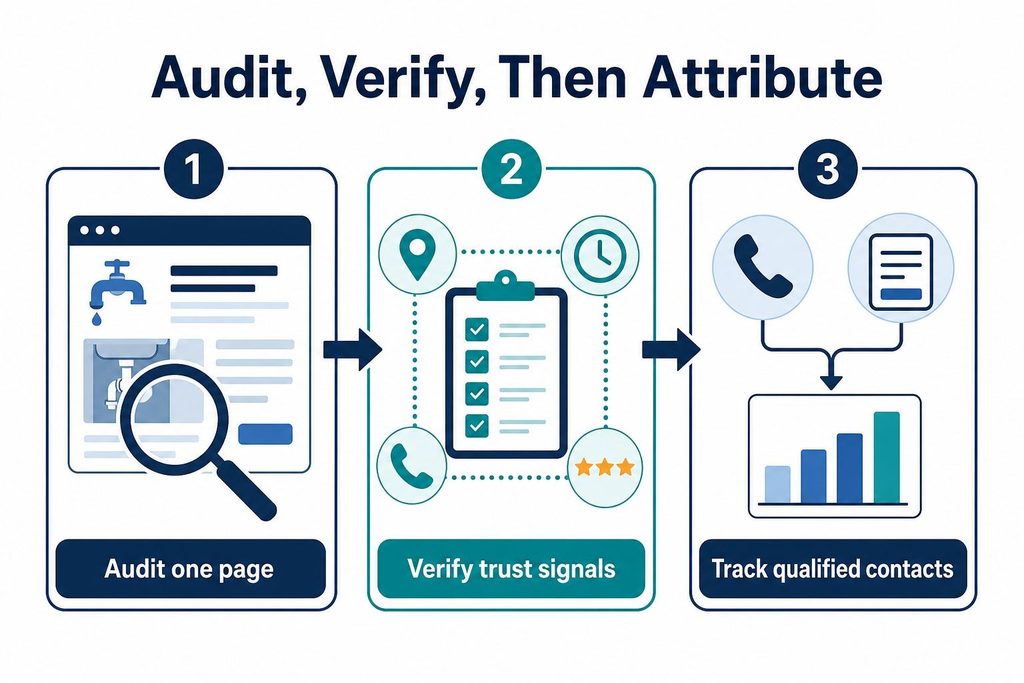
Sessions alone tell a budget holder nothing about whether the business grew. The standard worth tracking is qualified calls and booked work, broken down by service type and service area, because that is the only version of “traffic” that pays a crew’s wages.
The work breaks into three steps, and the order is not arbitrary:
- Pick one emergency service page and audit it closely. Inventory every emergency page currently live, then choose exactly one. One page, chosen deliberately, exposes the pattern faster than a broad review of the whole site, because it forces every weakness, missing proof, buried contact details, vague service-area language, into view at once rather than spreading attention thin.
- Verify the trust signals sitting next to that page. Check the Google Business Profile categories and hours, the service-area claims on the page itself, the phone number and form, and the reviews visible nearby. This has to come second because a page cannot outperform the trust signals sitting beside it: building on inaccurate local information wastes whatever comes after it.
- Set up call and form attribution on that page. Distinguish emergency-service contacts from general inquiries. Attribution comes last in this sequence because it is only useful once there is an accurate, trustworthy page underneath it worth measuring.
The one thing worth doing today, before anything else on this list: pick that single emergency drain cleaning page and read it the way someone standing in an inch of water would read it.